In this article
- Step 1: Get to the Safest Spot You Can
- Step 2: Make Your Truck Visible
- Step 3: Pin Down Your Exact Location
- Step 4: Describe the Problem Clearly
- Step 5: Protect the Load
- Step 6: Decide Between Roadside Repair and Towing
- Don’t Forget the Trailer
- What Not to Do After a Breakdown
- A Few Habits That Make Breakdowns Easier
- 24/7 Roadside Truck Repair Across DFW
- Frequently Asked Questions
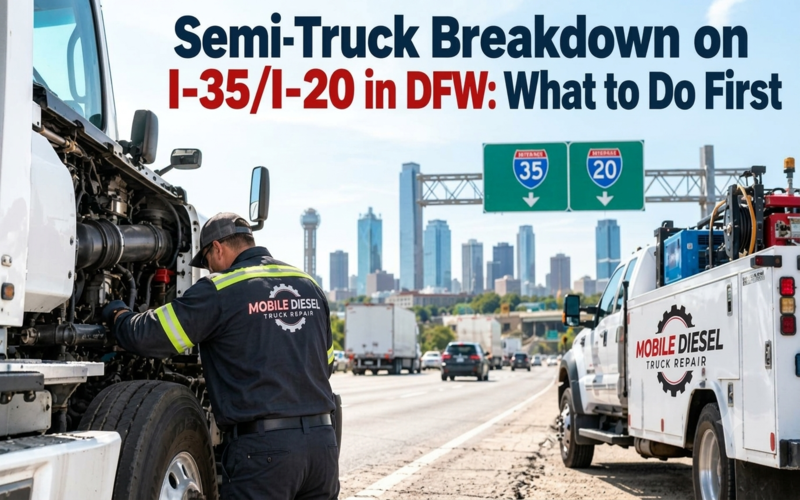
I-35 and I-20 are two of the busiest freight routes in Texas. On a normal day, they’re packed with 18-wheelers, commuters and construction zones. So when your truck loses power, blows a tire or throws a warning light in the middle of all that, it’s easy to feel the pressure.
The first few minutes after a breakdown matter more than most drivers realize. What you do in that window affects your safety, how fast help reaches you, what happens to your load and how much the whole thing ends up costing.
Our mechanics handle roadside truck repair calls across Dallas-Fort Worth every day. This is the step-by-step guide we wish every driver had saved in their phone.
Quick answer: If your semi breaks down on I-35 or I-20 in DFW, first get the truck as far off the road as safely possible, turn on your hazards and set out reflective triangles. Then call for help with your exact highway, direction of travel, nearest exit or mile marker and a description of the problem. Protect the load, notify your dispatcher and let a mechanic help you decide between roadside repair and towing.
Step 1: Get to the Safest Spot You Can
Your first job isn’t fixing the truck. It’s keeping yourself and other drivers safe.
If the truck is still moving, use the momentum you have:
- Signal early and move toward the right shoulder.
- Look for a wider spot, like an exit ramp, a wide shoulder or a frontage road. A few hundred extra feet can make a big difference.
- Avoid stopping on a curve, a hill or a bridge if you have any other choice. Other drivers need to see you.
- Watch for construction zones. Many stretches of I-35 and I-20 have narrow or missing shoulders during roadwork. If possible, roll past the zone before stopping.
If the truck stops in a travel lane and you can’t move it, turn on your hazards and call 911. A truck blocking a lane is an emergency, and law enforcement can help protect the scene.
Step 2: Make Your Truck Visible
Once you’re stopped, make sure every other driver knows you’re there.
- Turn on your hazard lights right away.
- Put on a high-visibility vest before you step out.
- Set out your reflective triangles. Federal rules require warning devices to be placed within 10 minutes of stopping. On a divided highway like I-35 or I-20, that typically means placing them about 10, 100 and 200 feet behind the truck, in the direction of approaching traffic.
- Exit on the side away from traffic whenever you can.
If standing outside feels unsafe, stay in the cab with your seatbelt on until help arrives. Drivers tend to drift toward what they’re looking at, and a stopped truck draws attention.
Texas has a Move Over or Slow Down law for stopped emergency and service vehicles, but not every driver follows it. Assume the traffic near you hasn’t seen you.
Step 3: Pin Down Your Exact Location
This is where a lot of time gets lost. “I’m on I-35 near Dallas” isn’t enough for a mechanic to find you quickly.
Before you call, have these details ready:
- Which I-35. In DFW, I-35 splits into I-35E through Dallas and I-35W through Fort Worth. Mixing them up can send help to the wrong side of the Metroplex.
- Direction of travel. Northbound, southbound, eastbound or westbound.
- Nearest exit number or mile marker.
- Nearest cross street or landmark, like an overpass, a truck stop or a big store.
- Which side of the road you’re on, and whether you’re on a main lane, ramp or frontage road.
- Whether you’re in or near managed express lanes, which have different access points.
- A GPS pin dropped from your phone, if you can share one.
The more precise you are, the faster a mobile mechanic can get to you.
Step 4: Describe the Problem Clearly
The person you call wants to send the right technician with the right parts. Tell them:
- Truck make, model, year and engine, if you know it
- What happened, like a loud bang, loss of power, smoke or a warning light
- Any fault codes showing on the dash
- Sounds, smells or leaks you’ve noticed
- Whether the truck still runs
- Whether the trailer is loaded or empty, and what kind of trailer it is
Photos help too. A picture of a blown tire, a leaking hose or a dash full of warning lights can tell a mechanic a lot before they arrive.
Step 5: Protect the Load
A breakdown doesn’t just put the truck at risk. It puts the freight, the delivery window and your customer relationship at risk too.
Notify your dispatcher or broker early. The sooner they know, the sooner they can adjust appointments, warn the customer or arrange a backup plan.
Keep refrigerated freight cold. If you’re pulling a reefer, check that the reefer unit is still running and has fuel. Note the temperature settings and readings. If the reefer unit itself is the problem, say so right away when you call for help.
Keep the trailer secure. Stay with the truck when you can, keep doors locked and check that the seal is intact. Breakdowns in busy areas can attract unwanted attention.
Follow hazmat procedures if you’re carrying hazardous materials. Keep your shipping papers within reach and follow your company’s emergency response instructions.
Document everything. Note the time, location, symptoms and who you called. Take photos of the truck, trailer and scene. This helps with insurance, customer questions and your own logs.
Keep your logs accurate. Record the breakdown time properly and follow your company’s hours-of-service policy. If you’re unsure, ask your safety department.
Step 6: Decide Between Roadside Repair and Towing
This is the big decision. Towing a loaded semi is expensive and slow, but some problems can’t be fixed on the shoulder.
| Situation | Roadside repair usually works | Towing is usually needed |
| Tires | Flats, blowouts, tire changes | Wheel or hub damage |
| Air brakes | Leaks, chambers, lines, slack adjusters | Major brake system damage |
| Electrical | Batteries, alternators, wiring, lights | Deep wiring faults needing long diagnostics |
| Fuel | Filters, priming, fuel delivery | Failed high-pressure fuel pump |
| Cooling | Hoses, belts, clamps | Major radiator or water pump failure in an unsafe spot |
| Engine | Sensors, many derates, minor leaks | Internal engine failure |
| Location | Wide shoulder, safe ramp, truck stop | No shoulder, active lane, unsafe spot |
A good mobile mechanic will be honest about which side of the line your problem falls on. Many common breakdowns can be handled with roadside semi truck repair, saving you the tow and hours of downtime. When a shop is the better choice, we’ll tell you and help you get the truck moved safely.
Don’t Forget the Trailer
Sometimes the truck is fine and the trailer is the problem. Trailer brakes, lights, air lines, landing gear and tires can all fail on the road.
Our emergency roadside truck and trailer repair service covers both, so you don’t have to call two different companies.
What Not to Do After a Breakdown
- Don’t keep driving on a blown tire or with air brake warnings. It can turn a small repair into a dangerous situation.
- Don’t open a hot radiator cap. Pressurized coolant can cause serious burns.
- Don’t stand on the traffic side of the truck longer than you need to.
- Don’t crank a no-start engine over and over. You can burn out the starter.
- Don’t wait too long to call. The earlier help is on the way, the faster you’re rolling again.
A Few Habits That Make Breakdowns Easier
You can’t prevent every breakdown, but you can make them less stressful:
- Save a 24/7 DFW truck repair number in your phone before you need it.
- Keep triangles, a hi-vis vest, a flashlight, gloves, water and a phone charger in the cab.
- Do thorough pre-trip inspections, especially tires, air lines and lights.
- Stay on top of fleet maintenance so small issues get caught early.
24/7 Roadside Truck Repair Across DFW
When you break down on I-35E, I-35W, I-20 or anywhere in the Metroplex, Mobile Diesel Truck Repair sends certified mechanics directly to you. We work on Freightliner, Kenworth, Peterbilt, Volvo, Mack and International trucks, with tools for CAT, Cummins, Detroit and PACCAR engines.
We serve Dallas, Grand Prairie, Carrollton, Denton, Plano, Wylie and beyond.
Call (972) 433-9450 or contact us for upfront pricing and fast dispatch.
Frequently Asked Questions
What should I do first if my semi breaks down on the highway?
Get as far off the road as safely possible, turn on your hazards, put on a hi-vis vest and set out your reflective triangles. Then call for help.
Where should I place warning triangles on a divided highway?
Typically about 10, 100 and 200 feet behind the truck, facing approaching traffic, within 10 minutes of stopping.
What information does a roadside mechanic need?
Your highway, direction, nearest exit or mile marker, truck make and model, symptoms, fault codes and whether the trailer is loaded.
Can a semi truck be repaired on the side of the highway?
Many problems can, including tires, air brake leaks, batteries, sensors, hoses and fuel filters. Major engine or transmission failures usually need a tow.
What if my truck is blocking a lane on I-35 or I-20?
Turn on your hazards and call 911 first. A truck in a travel lane is a safety emergency.